Prostate volume measurement is one of the most critical diagnostic tools in urology. Whether you're a patient trying to understand your test results or a medical professional seeking a refresher, this comprehensive guide covers everything you need to know about measuring the prostate gland accurately.
The size of your prostate directly influences treatment decisions, medication dosages, surgical approaches, and even the interpretation of your PSA test results. Yet despite its importance, many patients leave their doctor's office confused about what their prostate volume actually means.
Why Prostate Volume Matters
The prostate gland naturally grows throughout a man's life. By age 40, it typically weighs about 20-25 grams. By age 60, it may double in size. This growth, called Benign Prostatic Hyperplasia (BPH), affects over 50% of men by their sixth decade.
Accurate volume measurement serves several critical purposes:
- PSA Density Calculation: Dividing PSA by volume gives a more accurate cancer risk assessment than PSA alone
- Treatment Planning: Larger prostates may require different surgical approaches
- Medication Dosing: Some BPH medications have volume-based guidelines
- Monitoring Growth: Tracking size changes over time indicates disease progression
- Surgical Eligibility: Certain procedures have minimum/maximum size requirements
How Is Prostate Volume Measured?
There are several methods to measure prostate volume, each with different accuracy levels and clinical applications.
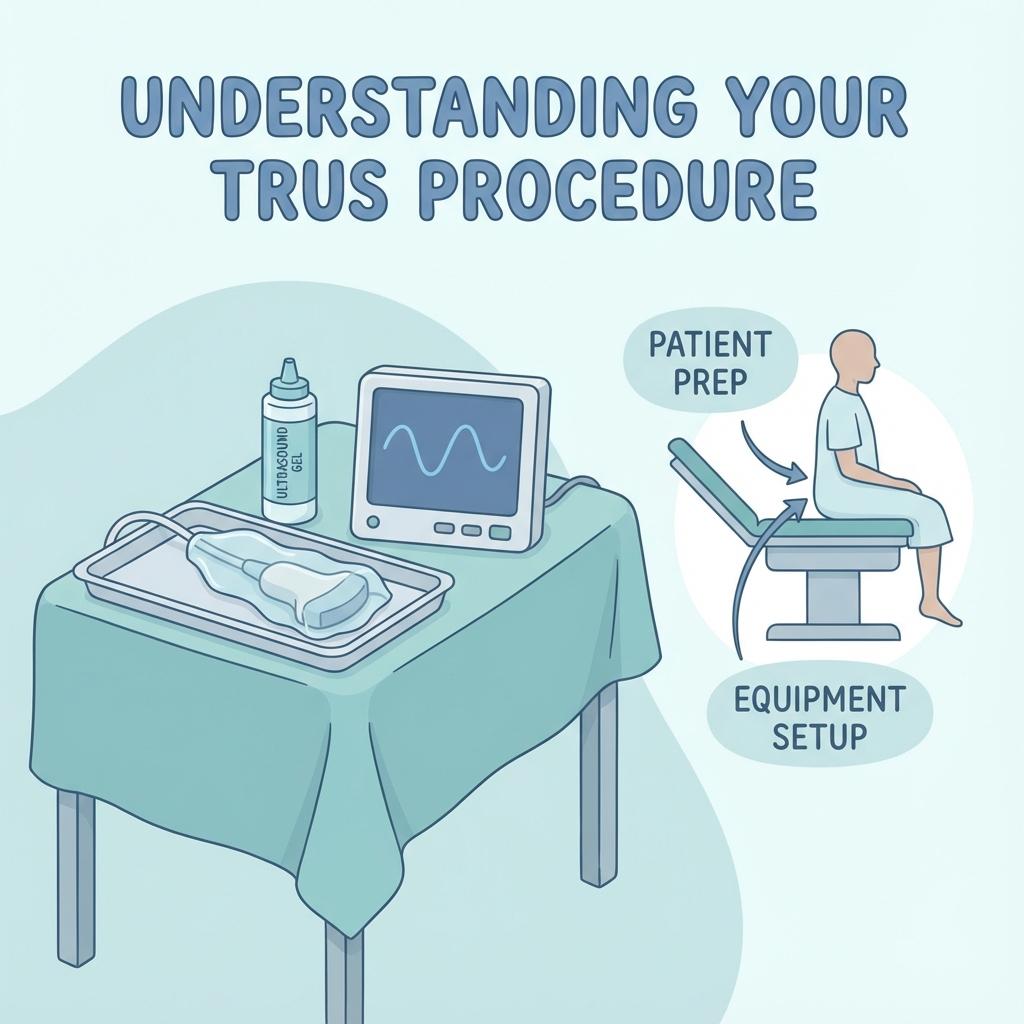
1. Transrectal Ultrasound (TRUS)
TRUS is the most common method for prostate volume measurement. A small ultrasound probe is inserted into the rectum to obtain images of the prostate from multiple angles.
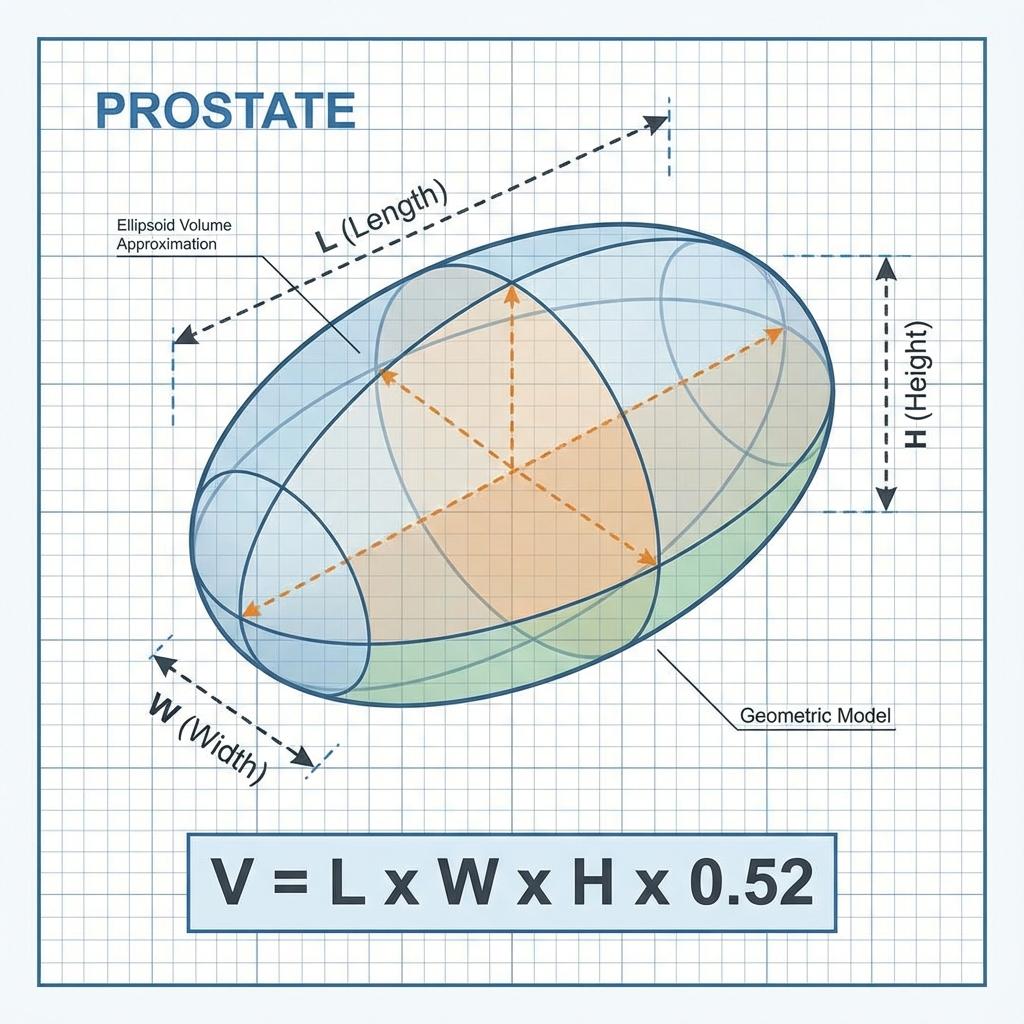
The technician measures three dimensions:
- Length (L): Also called anterior-posterior diameter, measured on sagittal view
- Width (W): Also called transverse diameter, measured on axial view
- Height (H): Also called superior-inferior or craniocaudal diameter
These measurements are then input into a mathematical formula to estimate total volume. Our Prostate Volume Calculator uses these same formulas used by radiologists worldwide.
2. MRI Volumetry
Magnetic Resonance Imaging provides the most accurate volume assessment. Unlike ultrasound, MRI can use planimetry—tracing the prostate outline on multiple slices and summing the areas.
Research shows MRI measurements are typically 15-20% more accurate than TRUS. However, MRI is more expensive and not always available. Learn more about the differences in our TRUS vs MRI comparison.
3. Digital Rectal Exam (DRE)
During a DRE, the doctor feels the prostate with a gloved finger. While useful for detecting nodules and assessing texture, DRE is highly inaccurate for volume estimation—especially for the portion of the prostate that extends beyond finger reach.
Studies show DRE underestimates prostate size by 30-50% compared to imaging. Never rely on DRE-based estimates for volume calculations.
The Mathematical Formulas
Once dimensions are measured, volume is calculated using mathematical formulas that approximate prostate shape.
Ellipsoid Formula (Standard)
The most widely used formula treats the prostate as an ellipsoid:
Volume = L × W × H × 0.52
Also written as: π/6 × L × W × H
The coefficient 0.52 (which equals π/6) comes from the formula for an ellipsoid's volume. This formula is endorsed by the American Urological Association (AUA) and used by most radiology departments.
Bullet (Prolate Spheroid) Formula
Some clinicians prefer the Bullet formula, which assumes a more cylindrical shape:
Volume = L × W × H × 0.65
Research suggests the Bullet formula may be more accurate for prostates with Benign Prostatic Hyperplasia, as BPH often causes the gland to become more spherical. Dive deeper into the mathematics in our detailed formula analysis.
Interpreting Your Results
Once you have a volume number, what does it mean? Here's how urologists interpret prostate size:
| Volume Range | Classification | Common Analogy |
|---|---|---|
| < 25 cc | Normal | Walnut |
| 25-30 cc | Upper Normal / Borderline | Golf Ball |
| 30-50 cc | Mildly Enlarged | Apricot |
| 50-80 cc | Moderately Enlarged | Lemon |
| > 80 cc | Severely Enlarged | Orange or larger |
Important: Size classification should always consider the patient's age. A 45cc prostate is concerning in a 40-year-old but may be normal for a 75-year-old. See our age-adjusted size chart for detailed reference ranges.
Volume and PSA Density
One of the most important applications of prostate volume is calculating PSA Density (PSAD):
PSA Density = PSA ÷ Prostate Volume
A PSAD below 0.15 ng/mL/cc suggests benign enlargement
Why does this matter? A man with a 100cc prostate and PSA of 8 ng/mL has a PSAD of 0.08—likely benign. A man with a 25cc prostate and the same PSA 8 has a PSAD of 0.32—concerning for cancer.
Learn more about how PSA Density can help avoid unnecessary biopsies in our comprehensive PSAD guide.
Volume and Treatment Decisions
Prostate volume directly influences treatment options:
Medication Therapy
5-alpha reductase inhibitors (finasteride, dutasteride) are most effective for prostates larger than 30-40cc. These medications can shrink the prostate by 20-30% over 6-12 months. Alpha-blockers work regardless of size but address symptoms, not growth.
Surgical Options
Different procedures are optimized for different sizes:
- TURP: Best for 30-80cc prostates
- Rezum/UroLift: Best for 30-80cc, certain shape requirements
- HoLEP: Excellent for any size, including 100cc+
- Simple Prostatectomy: Reserved for very large prostates (>100cc)
Our Prostate Weight Calculator can help estimate glandular mass for surgical planning.
Common Questions About Prostate Volume
Can prostate volume decrease?
Yes, with 5-alpha reductase inhibitors. Natural shrinkage is rare but can occur after certain infections or with extreme weight loss.
Is bigger always worse?
Not necessarily. Some men with 80cc prostates have minimal symptoms, while others with 35cc prostates are miserable. The relationship between size and symptoms is complex—learn more in our Volume and LUTS article.
How often should volume be measured?
For men on active surveillance for BPH, annual measurement is typical. Those on 5-alpha reductase inhibitors may be measured at 6-12 month intervals to assess medication response.
Using Our Volume Calculator
Our Prostate Volume Calculator allows you to:
- Calculate volume using both Ellipsoid and Bullet formulas
- Input measurements in centimeters or inches
- Automatically calculate PSA Density if you enter your PSA level
- Get age-adjusted interpretation of your results
- Save your calculation history locally
- Print or share your results with your doctor
Key Takeaways
- ✓ Prostate volume is measured using TRUS or MRI imaging
- ✓ The Ellipsoid formula (L × W × H × 0.52) is the clinical standard
- ✓ Volume affects PSA interpretation, treatment options, and surgical approach
- ✓ Normal size varies by age—always consider age-adjusted ranges
- ✓ PSA Density (PSA ÷ Volume) is often more informative than PSA alone
Ready to calculate your prostate volume? Use our free Prostate Volume Calculator to get instant, accurate results using the same formulas trusted by urologists worldwide.
Need to calculate prostate volume?
Use our free medical-grade calculator to get instant results using the Ellipsoid or Bullet formula.