The most dreaded words in a urology appointment: "You need a biopsy." It's invasive, uncomfortable, and carries risks of infection. But what if a simple math calculation could tell you if that biopsy is actually necessary?
Enter PSA Density (PSAD). By combining your blood test result with your prostate volume, this metric has become one of the most powerful tools in reducing unnecessary biopsies.
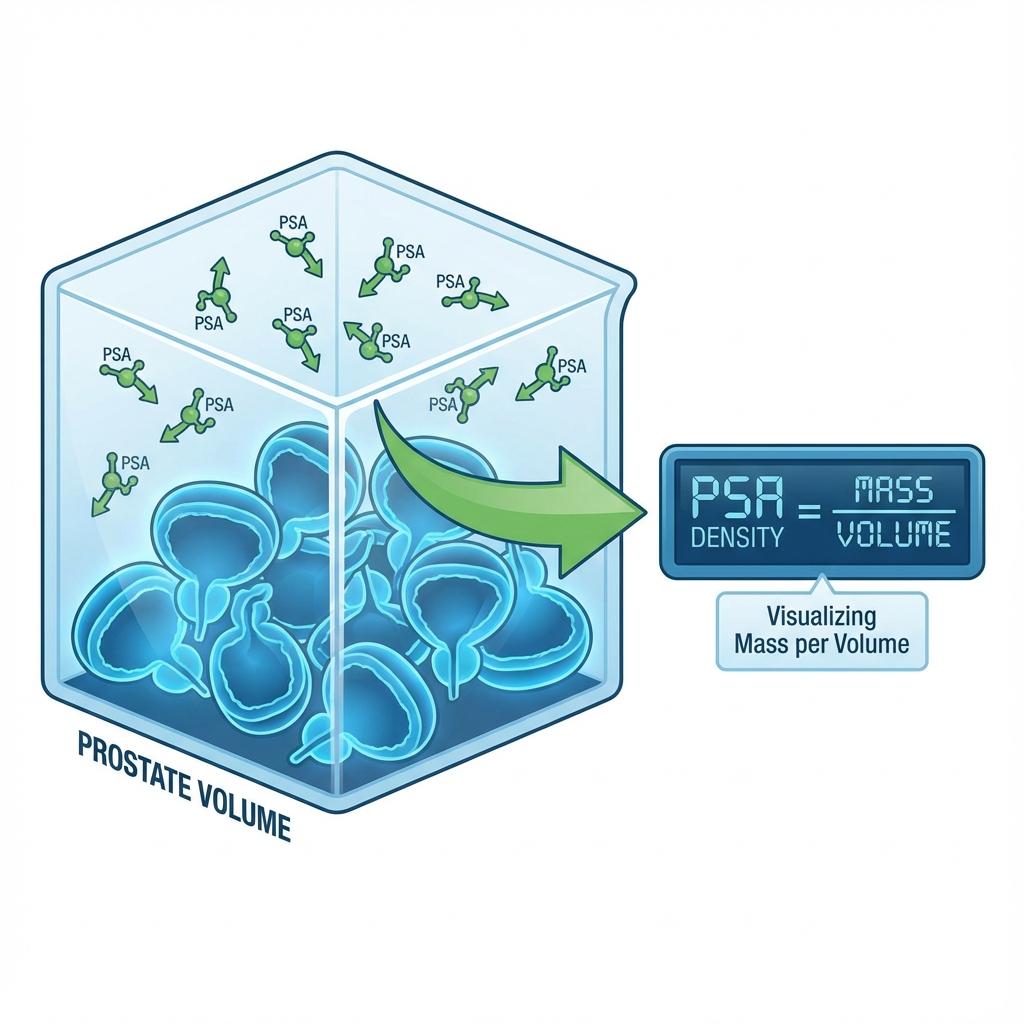
The "Gray Zone" Problem
For decades, the standard red flag was a PSA level between 4.0 and 10.0 ng/mL. This is known as the diagnostic "Gray Zone."
- The Problem: roughly 75% of men in this zone do NOT have cancer. They have BPH (Benign Prostatic Hyperplasia) or inflammation.
- The Consequence: Millions of men undergo biopsies that come back negative (benign). They suffer the pain and anxiety for nothing.
Why Density is the Solution
PSA Density adjusts the PSA level for the size of the gland.
Formula: PSA ÷ Volume (cc)
BPH (benign growth) produces PSA, but not efficiently. It pumps out about 0.1 ng/mL for every gram of tissue.
Cancer is a hyper-producer. It pumps out significantly more PSA per gram.
Therefore, a large gland with a high PSA might just be "acting its size." But a small gland with a high PSA is "punching above its weight"—and that is suspicious.
The Magic Number: 0.15
Extensive research has established 0.15 as the critical cutoff.
Scenario A: The "Big Benign" Prostate
- Total PSA: 6.5 ng/mL (High)
- Prostate Volume: 60 cc (Large)
- Density: 6.5 ÷ 60 = 0.108
- Verdict: Likely BPH. Biopsy often avoided.
Scenario B: The "Small Suspicious" Prostate
- Total PSA: 6.5 ng/mL (High)
- Prostate Volume: 30 cc (Normal)
- Density: 6.5 ÷ 30 = 0.216
- Verdict: Suspicious (>0.15). Biopsy recommended.
How Accurate is It?
Studies show that using PSA Density can prevent up to 50% of unnecessary biopsies while missing very few high-grade cancers.
It is particularly useful when combined with Multiparametric MRI (mpMRI).
- Negative MRI + Low Density: Risk of clinically significant cancer is extremely low (<5%). Biopsy can usually be safely deferred.
- Positive MRI + High Density: Biopsy is mandatory.
Getting an Accurate Volume
The weak link in PSA Density is the volume measurement.
If your doctor "estimates" your prostate size with a finger exam (DRE), the density calculation is useless. DRE is notoriously inaccurate for volume. You must have an imaging study:
- TRUS (Ultrasound): Good, but tends to underestimate size (making density look falsely high).
- MRI: The gold standard.
Conclusion
If your PSA is elevated, do not schedule a biopsy immediately. Ask for a volume measurement first. Calculate your density. If it is below 0.15, you may be able to engage in "Active Surveillance" or simply repeat the test in 6 months, sparing yourself an invasive procedure.
Need to calculate prostate volume?
Use our free medical-grade calculator to get instant results using the Ellipsoid or Bullet formula.