Receiving a Prostate-Specific Antigen (PSA) test result can be a source of anxiety for many men. A number appears on a page—perhaps it is flagged as "High"—and immediately thoughts turn to cancer. But modern urology looks far beyond this single digit.
The total PSA is just the tip of the iceberg. To truly understand your risk profile, you need to look at the nuances: PSA Density, PSA Velocity, Free PSA Percentage, and Age-Specific Ranges. This guide will teach you how to read your report like a urologist.
1. The Basics: What is PSA?
Prostate-Specific Antigen (PSA) is a protein produced by both normal and malignant cells of the prostate gland. Its function is to liquefy semen. Small amounts naturally leak into the bloodstream, which is what we measure.
It is crucial to understand that an elevated PSA is not a cancer diagnosis. It is specific to the prostate (only the prostate makes it), but not specific to cancer (many things cause it to rise).
Common Causes of High PSA (Non-Cancerous)
- Benign Prostatic Hyperplasia (BPH): As the prostate grows larger with age, it has more cells producing PSA. A big gland = more PSA.
- Prostatitis: Inflammation or infection causes "leaky" cells, dumping PSA into the blood. This can cause massive spikes (e.g., from 4 to 20 in weeks).
- Urinary Tract Infection (UTI): Irritation of the urinary tract.
- Recent Ejaculation or Cycling: Physical pressure or activity can transiently raise levels for 24-48 hours.
2. Advanced Metrics: The "Derivatives"
Because the "Total PSA" is so easily influenced by benign factors, doctors use derived metrics to increase accuracy.
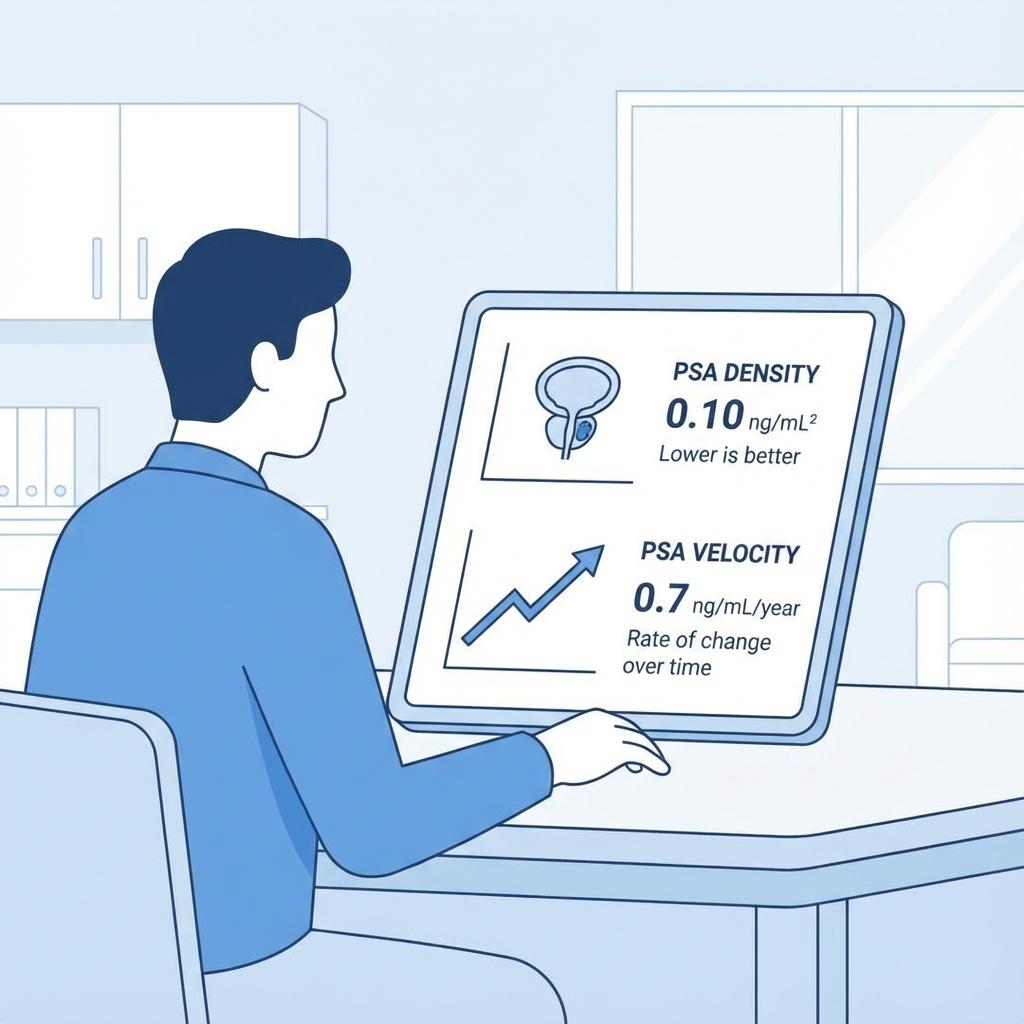
A. PSA Density (PSAD)
This is arguably the most important metric for men with an elevated PSA. It answers the question: "Is this high PSA just because I have a big prostate?"
Formula: PSA Density = Total PSA (ng/mL) ÷ Prostate Volume (cc)
The Logic: Benign prostate tissue produces a predictable amount of PSA (about 0.1 ng/mL per cc of tissue). Cancer cells produce significantly more.
- The Cutoff: 0.15
- If your Density is < 0.10, your high PSA is likely just BPH.
- If your Density is > 0.15, there is excess PSA production, raising suspicion of cancer.
Example: Two men both have a PSA of 8.0.
Man A has a 100cc prostate. Density = 8/100 = 0.08. (Likely BPH).
Man B has a 30cc prostate. Density = 8/30 = 0.27. (High Suspicion).
B. PSA Velocity (PSAV)
Velocity measures the speed of change. A PSA that slowly creeps up over 10 years is less concerning than one that doubles in 12 months.
- The Warning Sign: A rise of more than 0.75 ng/mL per year is suspicious.
- For men with lower PSA (< 4), a velocity > 0.35 ng/mL/year may warrant attention.
This highlights the importance of annual screening—it establishes a "baseline" so you can spot the acceleration.
C. Free PSA Percentage
PSA travels in the blood in two forms:
- Bound PSA: Attached to other proteins. (Cancer tends to produce this form).
- Free PSA: Floating unattached. (BPH tends to produce this form).
The % Free PSA test is usually reflexively ordered when Total PSA is between 4 and 10.
| % Free PSA | Cancer Probability |
|---|---|
| > 25% | Low (~8%) |
| 10% - 25% | Intermediate |
| < 10% | High (~56%) |
3. Age-Specific Reference Ranges
The old standard was "Anything over 4.0 is bad." We now know that PSA naturally rises with age as the prostate grows. A 4.0 is normal for a 70-year-old but alarming for a 40-year-old.
Typical Reference Ranges (Oesterling Guidelines):
- 40-49 years: 0.0 – 2.5 ng/mL
- 50-59 years: 0.0 – 3.5 ng/mL
- 60-69 years: 0.0 – 4.5 ng/mL
- 70-79 years: 0.0 – 6.5 ng/mL
Using these age-adjusted ranges prevents over-diagnosing older men and under-diagnosing younger men.
4. What Should You Do?
If your report shows an "H" (High) next to your PSA:
- Don't Panic: Remember the non-cancerous causes (BPH, bacterial infection, recent activity).
- Verify: Most doctors will repeat the test in 4-6 weeks to rule out a temporary spike.
- Calculate Density: Get an ultrasound or MRI to measure your prostate volume. Use our Calculator to check the density.
- Consider MRI: Before jumping to a biopsy, a Multiparametric MRI is now the gold standard. It can see if there are essentially any suspicious nodules. If the MRI is clean (PI-RADS 1 or 2), you may be able to avoid a biopsy entirely.
Conclusion
Your PSA, when viewed in isolation, is a crude instrument. But when combined with Volume (Density), Time (Velocity), and Fractions (% Free), it becomes a precise diagnostic tool. Empower yourself by asking your doctor about these advanced metrics.
Need to calculate prostate volume?
Use our free medical-grade calculator to get instant results using the Ellipsoid or Bullet formula.