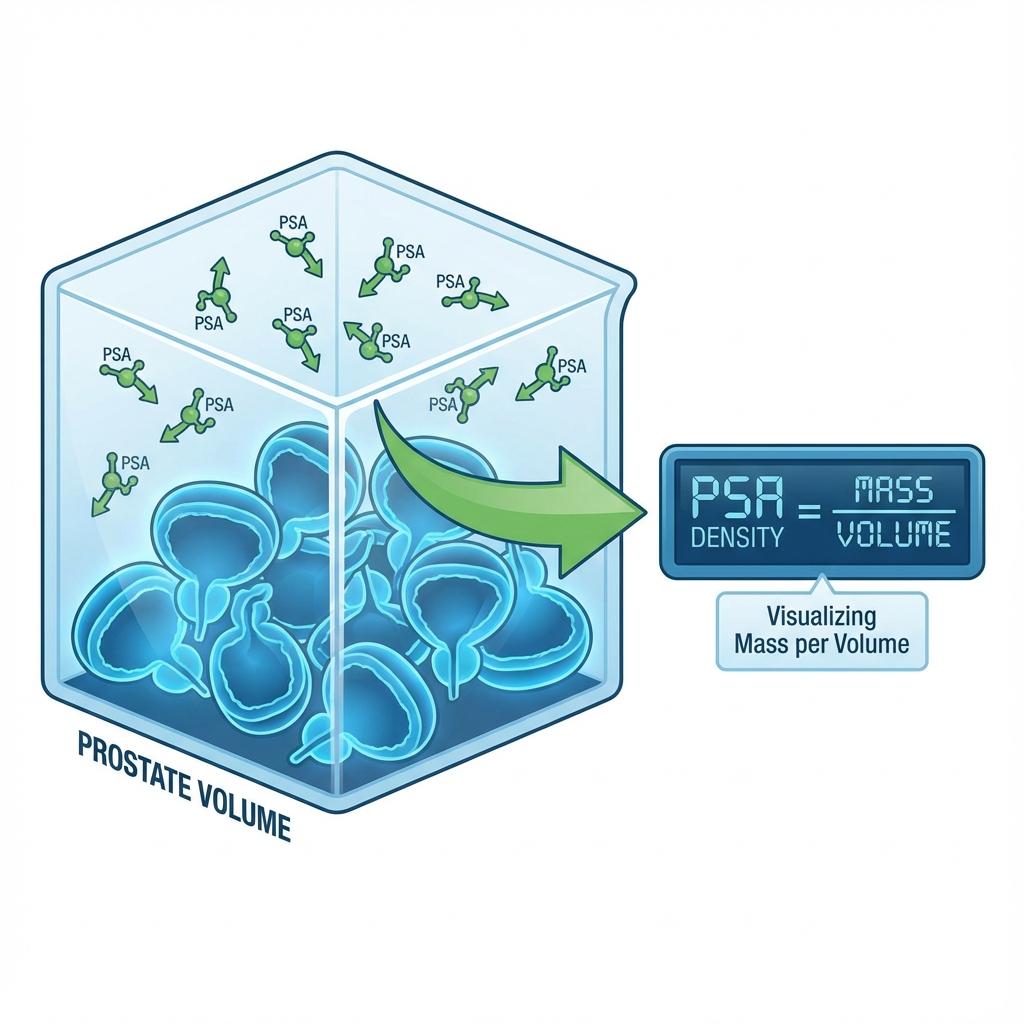
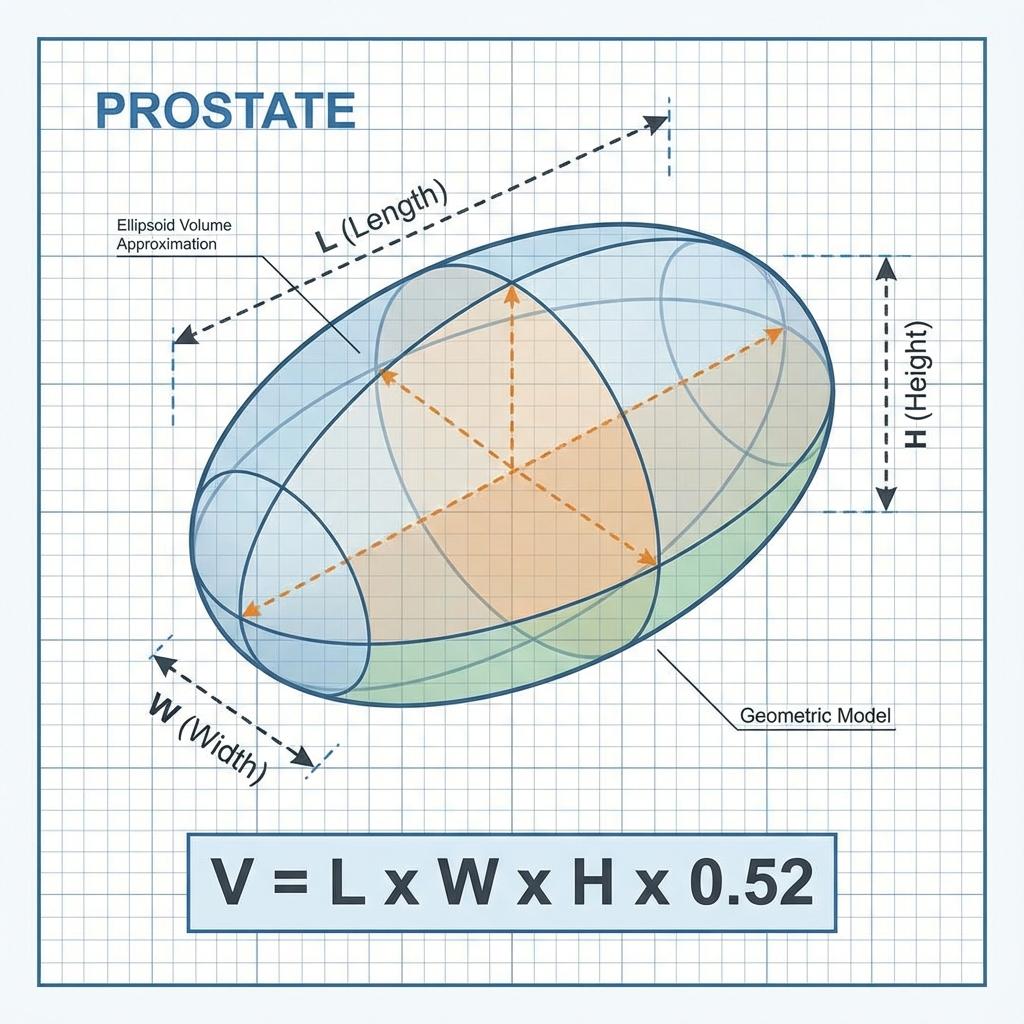
In prostate diagnostics, one number appears constantly: 0.52. You measure the Length, Width, and Height of the prostate, then multiply them by 0.52. But why? Is it a magic constant derived from biology?
The answer is surprisingly simple: it's pure geometry. Specifically, it is the mathematical relationship between a cube and a sphere. In this article, we'll break down the derivation of the prostate ellipsoid formula, explore alternative formulas like the "Bullet" calculation, and explain why using the wrong math can lead to the wrong diagnosis.
1. The Derivation: From Cube to Sphere
To understand where 0.52 comes from, imagine a perfect box (cube) and a perfect ball (sphere) fitting specifically inside it.
The Volume of a Box
If you measure the three dimensions of a box (Length, Width, Height), the volume is simply:
The Volume of a Sphere
The formula for the volume of a sphere is typically taught as:
However, in medicine, we measure diameters (the full width across), not radii (half width).
Substituting r = Diameter / 2:
- V = (4/3) × π × (D/2)³
- V = (4/3) × π × (D³ / 8) => (2³ is 8)
- V = (4/24) × π × D³
- V = (1/6) × π × D³
Now, let's look at that constant: π / 6.
π ÷ 6 ≈ 0.52359...
There it is. The 0.52 is simply a rounded version of Pi divided by 6. When we apply this to an ellipsoid (a stretched sphere) with three different diameters (L, W, H), the formula becomes:
Volume = L × W × H × (π/6)
2. The "Bullet" Formula: Why 0.66?
While the ellipsoid formula is the industry standard (and what is used in the Prostate Volume Calculator on this site), it is not perfect.
As men age and develop Benign Prostatic Hyperplasia (BPH), the prostate often does not grow symmetrically. It can elongate or widen, taking on a shape that looks more like a cylinder with rounded ends—often described as a "bullet" shape.
Understanding the Undercount
If you try to fit a bullet into a formula designed for an egg (ellipsoid), you will underestimate the volume. You are essentially chopping off the "corners" of the cylinder that the ellipsoid formula assumes aren't there.
To correct for this, some researchers proposed a hybrid formula between a cylinder and an ellipsoid.
- Cylinder Volume: Area of Base × Height = (π × r²) × H ≈ L × W × H × 0.785
- Ellipsoid Volume: L × W × H × 0.52
The "Bullet Formula" finds a middle ground, typically using a coefficient of 0.66 (or roughly π/4.8).
Clinical Impact
Using the Ellipsoid formula (0.52) on a bullet-shaped prostate might calculate a volume of 40cc. Using the Bullet formula (0.66) on the same dimensions would yield ~51cc.
This 25% difference changes the PSA Density significantly. A density of 0.18 (suspicious) could drop to 0.14 (normal) just by changing the math formula!
3. Which Formula is "Right"?
Despite the potential accuracy of the bullet formula for BPH, the Ellipsoid Formula (0.52) remains the global standard.
Why?
- Consistency: The 0.15 PSA Density cutoff was validated using the ellipsoid formula. If we switch formulas, we'd need to change the diagnostic cutoff too.
- Safety: Underestimating volume (using 0.52) results in a HIGHER calculated PSA density. This makes the test more "sensitive"—it is more likely to flag a patient for a biopsy. In cancer screening, we generally prefer to be safe (false positive) rather than miss a cancer (false negative).
4. The Future: Segmentation and Planimetry
The debate between 0.52 and 0.66 is becoming obsolete with the advent of modern MRI.
Radiologists no longer need to approximate shapes. Using MP-MRI Planimetry, software traces the exact contour of the prostate on every 3mm slice of the scan. It sums these slice areas to give a true volume, regardless of whether the prostate looks like an egg, a bullet, or a pear.
Studies show that planimetry is accurate to within 5% of surgical weight, whereas the ellipsoid formula has an error margin of 15-20%.
Conclusion
The number 0.52 is not magic—it's the ratio of a sphere to a cube (π/6). It assumes your prostate is a perfect ovoid. While this is a reasonable approximation for most men, outliers with bullet-shaped glands may have their volume underestimated.
When interpreting your results, always remember that these numbers are estimates derived from geometric models. They are guides, not absolute truths.
Need to calculate prostate volume?
Use our free medical-grade calculator to get instant results using the Ellipsoid or Bullet formula.