"Is my prostate normal for my age?" It's one of the most common questions men ask after seeing their test results. The answer isn't simple—what's normal at 70 would be concerning at 40. This comprehensive guide provides age-specific reference ranges to help you understand your measurements.
The prostate gland grows throughout a man's life in a process medically termed Benign Prostatic Hyperplasia (BPH). Understanding this natural progression helps distinguish normal aging from pathological enlargement requiring treatment.
Prostate Growth: The Natural Progression
At birth, the prostate is roughly the size of a pea. It grows rapidly during puberty under the influence of testosterone, reaching adult size by age 20-25. Then begins the second growth phase:
- Age 25-40: Minimal growth, stable at roughly 20-25cc
- Age 40-60: BPH begins; growth rate ~0.5-1cc per year
- Age 60+: Accelerated growth in many men; 2-3+ cc per year possible
By age 80, over 80% of men have some degree of BPH. This is normal aging—the question is whether the enlargement causes symptoms or complications.
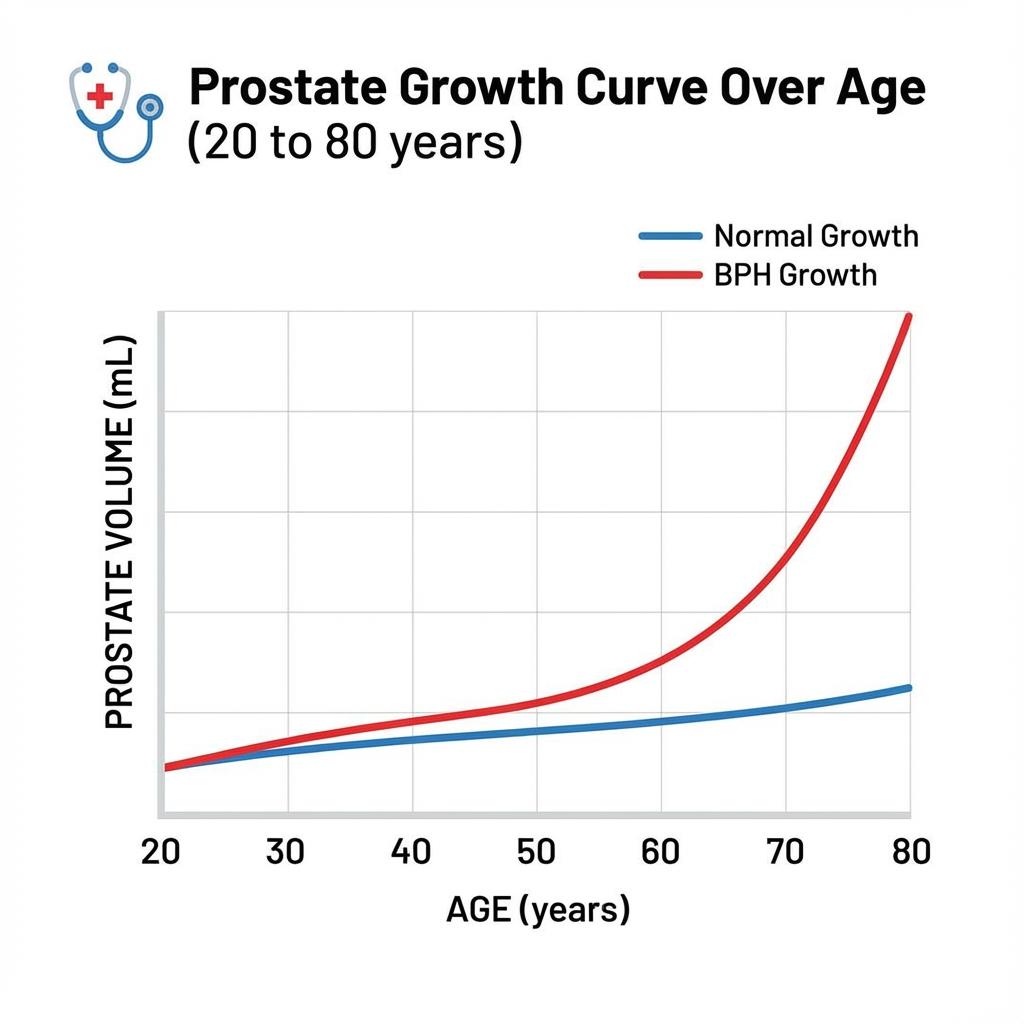
Normal Prostate Volume by Age
The following chart is compiled from population studies of asymptomatic men attending routine screening. These values represent what's statistically "normal"—not necessarily optimal.
| Age Group | Average Volume | Normal Range | Concerning If Above |
|---|---|---|---|
| 20-29 years | 20 cc | 15-25 cc | 25 cc |
| 30-39 years | 22 cc | 18-28 cc | 30 cc |
| 40-49 years | 25 cc | 20-35 cc | 35 cc |
| 50-59 years | 30 cc | 25-45 cc | 45 cc |
| 60-69 years | 35-40 cc | 30-55 cc | 55 cc |
| 70-79 years | 40-50 cc | 35-70 cc | 70 cc |
| 80+ years | 50+ cc | 40-80+ cc | Variable* |
*At 80+, the focus shifts from volume to symptoms and quality of life. Many asymptomatic men have prostates >80cc.
Calculate your volume now using our Prostate Volume Calculator to see where you fall on this chart.
Understanding Volume vs. Symptoms
Here's the critical point many patients miss: size doesn't equal symptoms.
- Some men with 80cc prostates urinate normally
- Some men with 35cc prostates have severe symptoms
- The relationship is complex and individual
Symptoms depend more on where the prostate grows (middle lobe vs. lateral lobes) and the individual's bladder function. Learn more about this in our Volume-Symptoms Connection article.
Size ≠ Symptoms
A large but asymptomatic prostate may need monitoring, not treatment. A moderately enlarged but highly symptomatic prostate may warrant intervention. Use our IPSS Score Quiz to quantify your symptoms.
Age-Adjusted PSA Interpretation
Volume isn't the only age-dependent value. PSA (Prostate-Specific Antigen) also correlates with age and prostate size.
Age-Specific PSA Reference Ranges
| Age | Traditional Cutoff | Age-Adjusted Upper Limit |
|---|---|---|
| 40-49 | 4.0 ng/mL | 2.5 ng/mL |
| 50-59 | 4.0 ng/mL | 3.5 ng/mL |
| 60-69 | 4.0 ng/mL | 4.5 ng/mL |
| 70-79 | 4.0 ng/mL | 6.5 ng/mL |
The Power of PSA Density
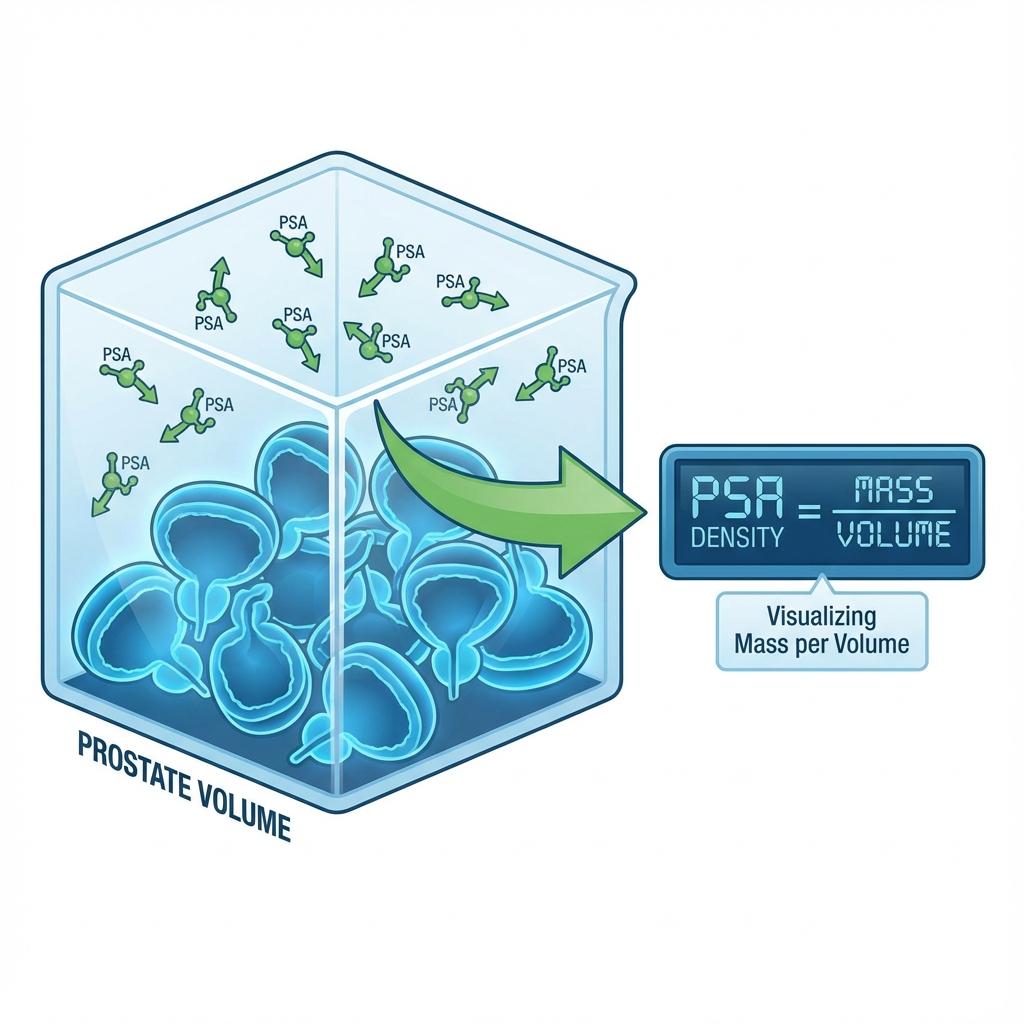
Because both PSA and volume increase with age, calculating PSA Density (PSA ÷ Volume) helps distinguish between:
- High PSA from BPH: More tissue = more PSA production (benign)
- High PSA from cancer: Abnormal cells produce excess PSA (concerning)
Our calculator automatically computes PSA Density when you enter your PSA level.
Risk Factors for Faster Growth
Some men experience prostate growth faster than average. Risk factors include:
- Family History: Men with fathers/brothers with BPH have higher risk
- Obesity: Higher body mass correlates with faster growth
- Diabetes: Insulin resistance may accelerate BPH
- Low Physical Activity: Exercise appears to slow prostate growth
- Cardiovascular Disease: Shared risk factors with BPH
Learn more about lifestyle modifications in our BPH Management Guide.
When to Seek Evaluation
Beyond comparing to age norms, seek urological evaluation if:
- Your prostate significantly exceeds the age-adjusted range (see chart above)
- You have LUTS (Lower Urinary Tract Symptoms) affecting quality of life
- Your PSA Density exceeds 0.15 ng/mL/cc
- You've had recurrent urinary tract infections
- You've experienced urinary retention (inability to urinate)
- Your symptoms are worsening despite treatment
Tracking Changes Over Time
Single measurements have limitations. What matters more is the trend:
- Stable: Prostate unchanged over 2-3 years → Reassuring
- Normal growth: ~1cc per year → Expected
- Rapid growth: >3cc per year → May need intervention
Our calculator's history feature (saved to your browser) helps you track measurements over time. Consistent measurement technique is essential—always compare TRUS to TRUS or MRI to MRI measurements.
Comparative Perspective
It helps to visualize these sizes:
| Volume | Roughly Size Of | Weight (~) |
|---|---|---|
| 20 cc | Walnut | 21 grams |
| 40 cc | Golf ball | 42 grams |
| 60 cc | Apricot/Lemon | 63 grams |
| 100 cc | Orange | 105 grams |
| 200+ cc | Grapefruit | 210+ grams |
Convert your volume to weight using our Prostate Weight Calculator.
Key Takeaways
- ✓ Normal prostate volume increases with age—30cc at 50 isn't the same as 30cc at 30
- ✓ The typical healthy range expands from 15-25cc (20s) to 40-80cc (70s)
- ✓ Size alone doesn't determine treatment need—symptoms matter more
- ✓ PSA should be interpreted alongside volume (PSA Density)
- ✓ Track trends over time rather than fixating on single measurements
Wondering where your prostate falls on the age-adjusted scale? Calculate your volume now with our free Prostate Volume Calculator and compare to these reference ranges.
Need to calculate prostate volume?
Use our free medical-grade calculator to get instant results using the Ellipsoid or Bullet formula.