When measuring prostate volume, two formulas dominate clinical practice: the Ellipsoid (coefficient 0.52) and the Bullet (coefficient 0.65). Both use the same three dimensions but produce different results. Which one should you trust?
The difference isn't trivial. For a prostate measuring 4 × 4 × 4 cm, the Ellipsoid formula gives 33cc while the Bullet formula gives 42cc—a 27% difference that could affect treatment decisions. Understanding when to use each formula is essential for accurate clinical practice.
The Mathematical Foundation
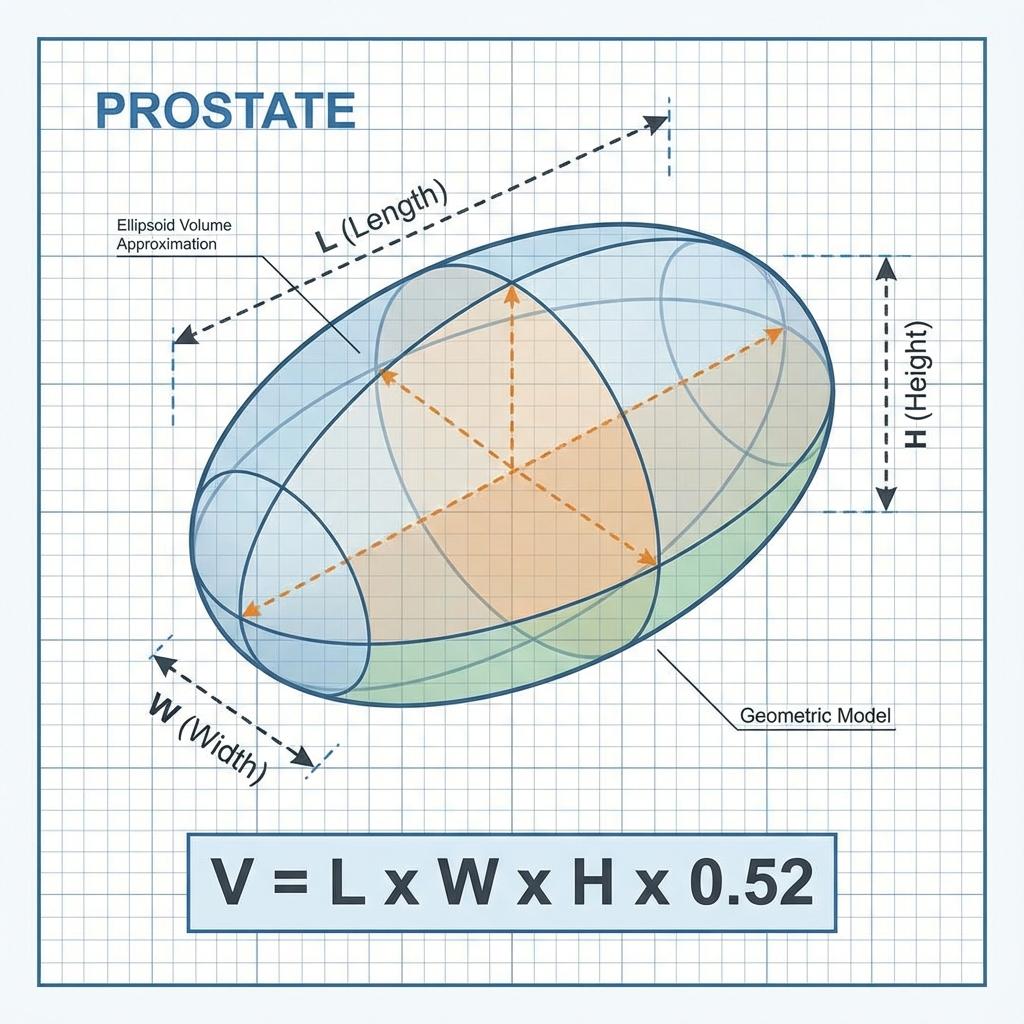
Both formulas approximate the prostate as a three-dimensional shape using length (L), width (W), and height (H) measurements from ultrasound or MRI.
Ellipsoid Formula
Volume = L × W × H × π/6
= L × W × H × 0.5236 (typically rounded to 0.52)
The Ellipsoid formula comes from the mathematical formula for an ellipsoid's volume. An ellipsoid is like a three-dimensional oval—stretched differently in each direction. The formula π/6 × a × b × c gives the exact volume when a, b, and c are the semi-axes (half the diameters).
Since we measure full diameters (not semi-axes), the formula becomes π/6 × (L/2) × (W/2) × (H/2) × 8 = π/6 × L × W × H.
Bullet (Prolate Spheroid) Formula
Volume = L × W × H × 0.65
Also written as: 5/12 × π × L × W × H
The Bullet formula models the prostate as a prolate spheroid—like a bullet or an American football. This shape assumption comes from the observation that enlarged prostates often become more rounded and symmetrical as they grow.
What the Research Shows
Several studies have compared these formulas against the gold standard: step-section planimetry on MRI, where the prostate is traced slice-by-slice for maximum accuracy.
1991 Terris & Stamey Study
The landmark study by Terris and Stamey established the Ellipsoid formula as the clinical standard. They found that for normal-sized prostates, the 0.52 coefficient provided the best correlation with actual specimen weights.
Volume-Dependent Accuracy
Subsequent research revealed a pattern: the optimal coefficient changes with prostate size.
- Small prostates (<30cc): Ellipsoid (0.52) is more accurate
- Medium prostates (30-60cc): Both formulas perform similarly
- Large prostates (>60cc): Bullet (0.65) may be more accurate
This makes intuitive sense. As BPH causes the prostate to grow, it tends to become more spherical—matching the Bullet formula's assumptions more closely.
2013 Korean Study
A study of 152 patients who underwent radical prostatectomy compared formula-calculated volumes to actual specimen weights. Key findings:
- Ellipsoid formula underestimated true volume by 8.4% on average
- A coefficient of 0.58 provided the best overall accuracy
- Neither formula was perfect across all size ranges
Real-World Comparison
Let's see how the formulas compare across different prostate sizes:
| Dimensions (cm) | Ellipsoid (0.52) | Bullet (0.65) | Difference |
|---|---|---|---|
| 3 × 3 × 3 | 14.0 cc | 17.6 cc | +25% |
| 4 × 4 × 3 | 25.0 cc | 31.2 cc | +25% |
| 5 × 5 × 4 | 52.0 cc | 65.0 cc | +25% |
| 6 × 5 × 5 | 78.0 cc | 97.5 cc | +25% |
The Bullet formula always gives 25% higher values (0.65/0.52 = 1.25). This consistent difference means choosing the wrong formula could significantly impact clinical decisions.
Clinical Implications
PSA Density Interpretation
Using the Ellipsoid formula with a PSA of 6 and dimensions of 5 × 5 × 4 cm:
- Volume = 52 cc → PSA Density = 0.115 (Low risk)
Using the Bullet formula:
- Volume = 65 cc → PSA Density = 0.092 (Very low risk)
Both suggest low cancer risk, but the difference could matter in borderline cases. Learn more about PSA Density thresholds.
Treatment Eligibility
Some procedures have volume-based cutoffs:
- UroLift: Approved for prostates 30-80cc
- Rezum: Best for 30-80cc
- Simple Prostatectomy: Usually considered above 80-100cc
A prostate measuring 5.5 × 5 × 5 cm calculates to 71cc (Ellipsoid) or 89cc (Bullet). One formula keeps the patient eligible for minimally invasive therapy; the other suggests open surgery.

Which Formula Should You Use?
Given the research and clinical considerations, here are evidence-based recommendations:
Use Ellipsoid (0.52) When:
- Following standard radiology reporting protocols
- Calculating PSA Density (most research uses Ellipsoid)
- Working with normal-sized or mildly enlarged prostates
- Comparing to historical measurements done with Ellipsoid
Consider Bullet (0.65) When:
- The prostate is significantly enlarged (>60cc by Ellipsoid)
- The gland appears very spherical on imaging
- Planning surgery where accurate weight estimation matters
- The institution's protocol specifies Bullet formula
Best Practice: Calculate Both
Our Prostate Volume Calculator allows you to calculate volume using both formulas simultaneously. This gives you:
- A range of likely volumes
- The ability to track measurements consistently over time
- Flexibility to report whichever your physician prefers
Beyond Simple Formulas
For maximum accuracy, consider these advanced approaches:
MRI Planimetry
Direct tracing of the prostate on each MRI slice, then summing the volumes. This is the gold standard with accuracies within 5% of true volume. Read our TRUS vs MRI comparison.
3D Ultrasound
Newer 3D ultrasound systems can calculate volume automatically using hundreds of measurements, reducing operator dependency.
AI-Assisted Measurement
Machine learning algorithms are being developed to segment the prostate automatically and calculate volumes without formula assumptions.
Common Misconceptions
"The higher number is safer"
False. Using an artificially high volume gives a falsely low PSA Density, potentially missing cancer.
"Formulas don't matter much"
False. A 25% difference can change treatment eligibility, PSA interpretation, and surgical planning.
"MRI-derived volumes are always better"
Mostly true, but... If the same formula is used on MRI measurements, the same coefficient limitations apply. Only MRI planimetry avoids formula-based error.
Key Takeaways
- ✓ Ellipsoid (0.52) is the clinical standard backed by AUA guidelines
- ✓ Bullet (0.65) may be more accurate for large, spherical prostates
- ✓ The formulas differ by exactly 25% in their results
- ✓ Use the same formula for serial measurements to track changes
- ✓ When in doubt, report both values to your physician
Ready to compare the formulas yourself? Try our Prostate Volume Calculator to see results from both methods instantly.
Need to calculate prostate volume?
Use our free medical-grade calculator to get instant results using the Ellipsoid or Bullet formula.