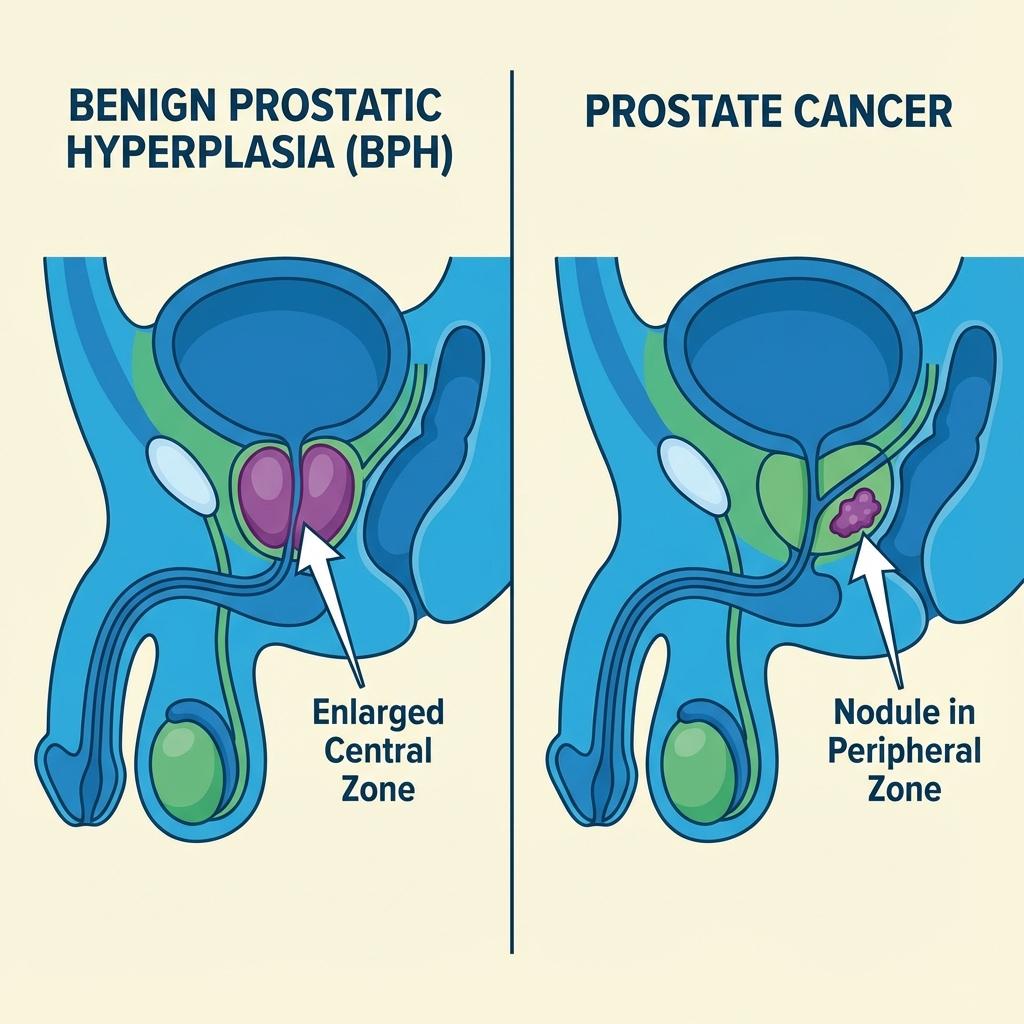
TURP and HoLEP are two of the most effective surgical treatments for BPH. While both provide excellent outcomes, prostate size significantly influences which procedure is optimal. Understanding this relationship helps you have informed discussions with your surgeon.
First, calculate your prostate weight using our Weight Calculator to understand where you fall.
Overview of Each Procedure
TURP (Transurethral Resection of the Prostate)
- A wire loop shaves tissue from inside the prostate
- Done through the urethra (no external incisions)
- ~1 gram of tissue removed per minute
- The "gold standard" for 40+ years
HoLEP (Holmium Laser Enucleation of the Prostate)
- Holmium laser removes entire adenoma in one piece
- Also transurethral (no external incisions)
- Tissue morcellated (cut up) for removal
- Newer but increasingly preferred for large glands

Prostate Size Recommendations
| Prostate Weight | Preferred Procedure | Rationale |
|---|---|---|
| <30g | Either/Alternative | Both quick; office procedures may suffice |
| 30-50g | TURP or HoLEP | Both excellent; surgeon preference matters |
| 50-80g | TURP or HoLEP | TURP approaches time limits; HoLEP may be preferred |
| 80-100g | HoLEP preferred | TURP prolonged; HoLEP more efficient |
| >100g | HoLEP strongly preferred | TURP often impractical; HoLEP size-independent |
Why Size Matters for TURP
Time Limitations
TURP becomes problematic beyond 60-90 minutes due to:
- TUR Syndrome Risk: Irrigation fluid absorption increases with time
- Blood Loss: Scales with resection volume
- Incomplete Resection: Surgeon may not remove all obstructing tissue
At ~1g/minute, a 100g prostate would require 90+ minutes of resection—pushing limits.
Staged Procedures
Very large prostates may require two TURP sessions (staged TURP), increasing:
- Total anesthesia exposure
- Hospital stays
- Time to symptom relief
Why HoLEP Handles Large Prostates
Size-Independent Efficiency
HoLEP enucleates the adenoma as a whole, regardless of size:
- 100g prostate: ~90 minutes
- 200g prostate: ~120 minutes (only 30 minutes more)
The technique scales better than resection.
Lower Blood Loss
Laser energy coagulates vessels as it cuts:
- Blood loss 50-70% less than TURP for equivalent sizes
- Lower transfusion rates
- Safer for patients on anticoagulation
Complete Removal
HoLEP removes nearly 100% of adenoma tissue:
- Lower retreatment rates (1-2% at 5 years vs. 5-10% for TURP)
- More durable symptom relief
Head-to-Head Comparison
| Factor | TURP | HoLEP |
|---|---|---|
| Optimal size | 30-80g | Any (especially >80g) |
| Hospital stay | 1-2 days | 1-2 days (often same-day for smaller) |
| Catheter time | 1-3 days | 1-2 days |
| Blood loss | Higher | Lower |
| Retreatment rate | 5-10% at 5 years | 1-2% at 5 years |
| Learning curve | Shorter | Longer (40-50 cases) |
| Availability | Universal | Specialized centers |
Other Considerations
Anticoagulation
HoLEP's lower blood loss makes it preferred for men on blood thinners who cannot safely stop medication.
Surgeon Experience
HoLEP has a learning curve. An experienced TURP surgeon may achieve better results than a novice HoLEP surgeon.
Ejaculatory Function
Both procedures commonly cause retrograde ejaculation (75-90%). Alternative procedures (UroLift, Rezum) preserve ejaculatory function better.
Questions to Ask
- What is my prostate weight?
- Which procedure do you recommend and why?
- How many HoLEP procedures have you performed?
- What are the expected outcomes for my size?
- Should I consider referral to a HoLEP specialist?
Key Takeaways
- ✓ TURP works best for prostates 30-80g
- ✓ HoLEP is size-independent and preferred for >80g
- ✓ HoLEP has lower retreatment rates and blood loss
- ✓ TURP is more widely available; HoLEP requires specialized centers
- ✓ Both have excellent outcomes when matched to appropriate patients
Calculate your prostate weight with our Weight Calculator to see which procedure range you fall into.
Need to calculate prostate volume?
Use our free medical-grade calculator to get instant results using the Ellipsoid or Bullet formula.