Your PSA is rising faster than expected. At what point does PSA Doubling Time (PSADT) change from "watchful concern" to "time to act"? This guide explains the treatment trigger points used by major cancer centers worldwide.
Context Matters
PSADT triggers differ based on your clinical situation:
- Pre-diagnosis: When considering initial biopsy
- Active surveillance: Deciding when to move to definitive treatment
- Post-treatment recurrence: Choosing salvage therapy vs. systemic treatment
Calculate your PSADT with our free calculator.
Pre-Diagnosis: When to Biopsy
If PSA is elevated but you haven't been diagnosed with cancer:
Traditional Approach
PSA >4 ng/mL generally triggered biopsy. But this misses context.
Modern Approach Incorporates PSADT
- PSA 4-10 ng/mL with PSADT >3 years: MRI first, selective biopsy
- PSA 4-10 ng/mL with PSADT <3 years: Higher suspicion, MRI + likely biopsy
- Any PSA with PSADT <1 year: Urgent evaluation
PSA Density Also Matters
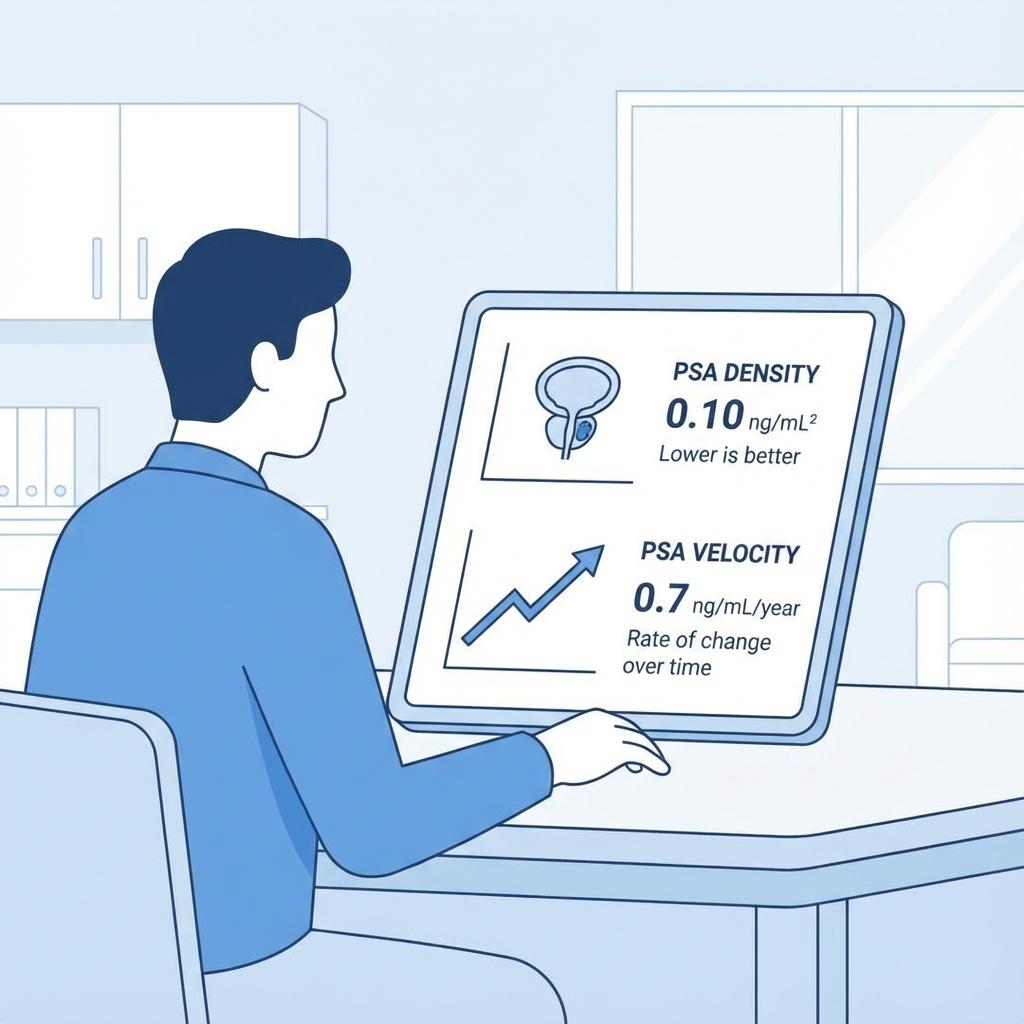
Combine PSADT with PSA Density (PSA ÷ Volume) for better risk stratification. Use our Prostate Volume Calculator to calculate density.
Active Surveillance: Trigger Points
For men on active surveillance for low-risk prostate cancer:
| PSADT | Typical Action |
|---|---|
| >3 years | Continue surveillance per protocol |
| 2-3 years | Closer monitoring, earlier MRI/biopsy |
| 1-2 years | Strongly consider treatment |
| <1 year | Treatment typically recommended |
The 3-Year Rule
Most protocols (Johns Hopkins, Toronto, PRIAS) use PSADT <3 years as a trigger for intervention discussion. This doesn't mean automatic surgery—it means:
- Detailed treatment discussion
- Repeat biopsy if not done recently
- MRI to assess for progression
- Patient preference heavily weighted
Post-Treatment Recurrence
After prostatectomy or radiation, rising PSA (biochemical recurrence) requires decisions about next steps:
Post-Prostatectomy
PSA should be undetectable after surgery. If it rises:
- PSADT >12 months: Likely local recurrence; salvage radiation often effective
- PSADT 6-12 months: Borderline; imaging and individual assessment
- PSADT <6 months: Higher metastatic risk; systemic therapy considered
- PSADT <3 months: Aggressive disease; combination systemic therapy
Post-Radiation
PSA nadir after radiation typically takes 18-24 months. If PSA then rises:
- Rising PSA + PSADT >1 year: Salvage options (prostatectomy, cryotherapy) considered
- Rising PSA + PSADT <6 months: Systemic therapy more likely needed

Treatment Options by Scenario
Local Treatment (PSADT > 10-12 months)
- Salvage radiation (post-prostatectomy)
- Salvage prostatectomy (post-radiation)
- HIFU, cryotherapy (selected cases)
Systemic Treatment (PSADT < 6 months)
- Androgen Deprivation Therapy (ADT)
- ADT + second-generation antiandrogens
- Clinical trial consideration
Combination Approaches (PSADT 6-12 months)
- Radiation + ADT
- Molecular imaging (PSMA PET) to guide therapy
- Individual risk-benefit assessment
The Role of Imaging
Modern imaging with PSMA PET/CT is changing treatment decisions:
- Can detect metastases at lower PSA levels
- May allow focal treatment of oligometastatic disease
- Helps distinguish local vs. distant recurrence regardless of PSADT
Patient Factors
Beyond PSADT, treatment decisions consider:
- Age and life expectancy: Younger men may tolerate aggressive treatment
- Comorbidities: Health status affects treatment tolerance
- Patient preference: Quality of life considerations
- Original tumor grade: High-grade disease at diagnosis raises concern
Key Takeaways
- ✓ PSADT <3 years triggers treatment discussion in active surveillance
- ✓ Post-treatment, PSADT helps distinguish local vs. metastatic recurrence
- ✓ Faster doubling (<6-12 months) often means systemic therapy needed
- ✓ Slower doubling (>12 months) often allows local salvage options
- ✓ Context (pre-diagnosis, surveillance, post-treatment) changes interpretation
Calculate your PSA trajectory with our free PSADT Calculator.
Need to calculate prostate volume?
Use our free medical-grade calculator to get instant results using the Ellipsoid or Bullet formula.