Your PSA went from 4.2 to 5.8 over two years. Is that alarming or normal? The rate of PSA change—whether it's rising slowly or rapidly—often matters more than the absolute number. Understanding PSA kinetics helps distinguish concerning patterns from benign fluctuations.
Why Rate of Change Matters
A single PSA value is a snapshot. But cancer grows exponentially over time. By tracking the rate of rise, we gain insight into:
- Whether PSA elevation is due to BPH or cancer
- How aggressive a known cancer may be
- When to recommend biopsy or treatment changes
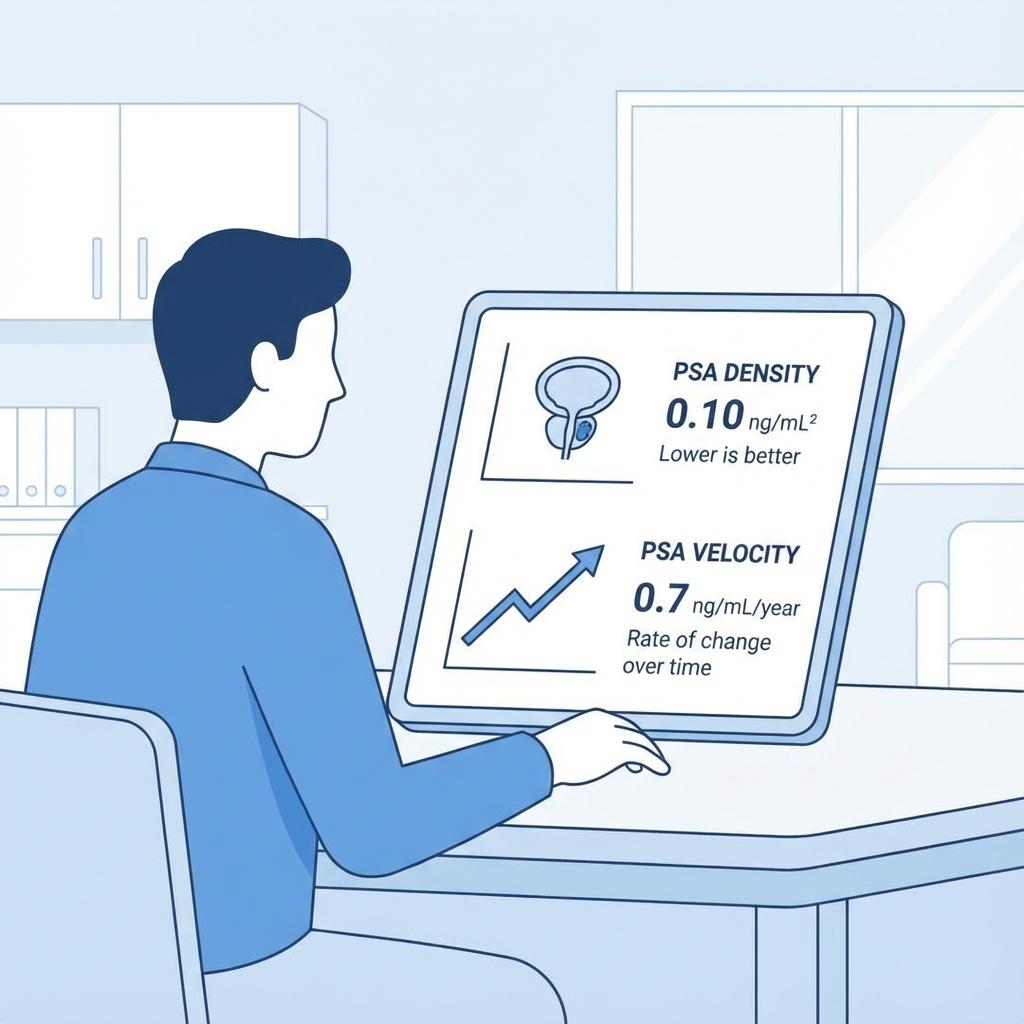
PSA Velocity vs. PSA Doubling Time
Two ways to measure PSA change:
PSA Velocity (PSAV)
The absolute change in PSA per year:
PSAV = (PSA₂ - PSA₁) / Time in years
Example: PSA rises from 4.0 to 6.0 over 2 years → PSAV = 1.0 ng/mL/year
PSA Doubling Time (PSADT)
The time it takes PSA to double. This accounts for exponential growth patterns:
Calculate yours with our PSADT Calculator.
What's Considered "Fast"?
| PSA Velocity | Interpretation |
|---|---|
| <0.35 ng/mL/year | Normal (consistent with BPH) |
| 0.35-0.75 ng/mL/year | Borderline; warrants monitoring |
| >0.75 ng/mL/year | Elevated; increased cancer suspicion |
| >2.0 ng/mL/year | Rapid; urgent evaluation needed |
Slow PSA Rise: Often Benign
A gradual PSA increase is commonly due to:
Benign Prostatic Hyperplasia (BPH)
- Prostate grows ~1-2% per year after age 40
- More tissue = more PSA production
- PSA typically rises 0.1-0.3 ng/mL/year from BPH
Calculate your prostate volume to understand if BPH explains your PSA.
Age-Related Increase
Even without pathology, PSA rises with age. Reference ranges adjust accordingly:
- Age 40-49: Up to 2.5 ng/mL normal
- Age 50-59: Up to 3.5 ng/mL normal
- Age 60-69: Up to 4.5 ng/mL normal
- Age 70-79: Up to 6.5 ng/mL normal
Reassuring Pattern
PSA 3.5 → 4.0 → 4.5 over 4 years = PSAV 0.25 ng/mL/year. This slow trajectory, especially in a man with large prostate volume, is usually benign.
Fast PSA Rise: When to Worry
Rapid PSA increase raises red flags:
Cancer Suspicion
- PSAV >0.75 ng/mL/year is associated with higher cancer risk
- PSADT <12 months suggests aggressive biology
- Even if current PSA is "normal," rapid rise warrants investigation
Aggressive Cancer
Post-diagnosis or post-treatment, rapid PSA rise suggests:
- Higher Gleason grade cancer
- Increased metastatic potential
- May need treatment escalation
Concerning Pattern
PSA 4.5 → 6.0 → 8.5 over 18 months = PSADT ~10 months. This rapid doubling warrants MRI and likely biopsy regardless of absolute PSA level.

What Causes Sudden PSA Spikes?
Not all rapid PSA increases indicate cancer:
Temporary Elevations
- Prostatitis: Infection can double or triple PSA
- Recent biopsy: Elevates PSA for 2-4 weeks
- Urinary retention: Temporary spike
- Recent ejaculation: Minor increase for 24-48 hours
- Vigorous exercise: Cycling especially
When to Recheck
If PSA spikes unexpectedly:
- Rule out infection (urinalysis, symptoms)
- Repeat PSA in 4-6 weeks
- If elevation persists, proceed with evaluation
Clinical Decision-Making
Before Biopsy
PSA kinetics influence biopsy recommendations:
- Slow rise + large prostate + low PSA density → May avoid biopsy
- Rapid rise + normal volume + high PSA density → Biopsy advised
Active Surveillance
For men with low-risk cancer on surveillance:
- PSADT >3 years: Continue surveillance
- PSADT <3 years: Consider intervention (many protocols)
Post-Treatment
After surgery or radiation:
- PSADT >10-12 months: Likely local recurrence
- PSADT <6-10 months: Higher risk of metastases
How to Track Your PSA
- Keep all PSA results in one document
- Note the date and laboratory for each test
- Use same lab when possible (different assays vary)
- Use our PSADT Calculator to quantify your trend
- Share trends with your urologist
Key Takeaways
- ✓ PSA trend (velocity/doubling time) often matters more than single values
- ✓ Slow rise (<0.35 ng/mL/year) is usually benign BPH
- ✓ Fast rise (>0.75 ng/mL/year) warrants evaluation
- ✓ Single spikes may be temporary—repeat before worrying
- ✓ Track your PSA history to provide meaningful data to your doctor
Calculate your PSA trajectory with our free PSA Doubling Time Calculator.
Need to calculate prostate volume?
Use our free medical-grade calculator to get instant results using the Ellipsoid or Bullet formula.