As men age, the prostate acts up. It's an almost universal fact of life. But when symptoms start—waking up at night to pee, a weak stream, or a high PSA test—the immediate fear is: "Is it cancer?"
Fortunately, for the vast majority of men, the answer is no. It is likely **Benign Prostatic Hyperplasia (BPH)**. While BPH and prostate cancer both involve the growth of the prostate, they are two completely distinct conditions. They grow in different parts of the gland, cause different symptoms, and are treated very differently.
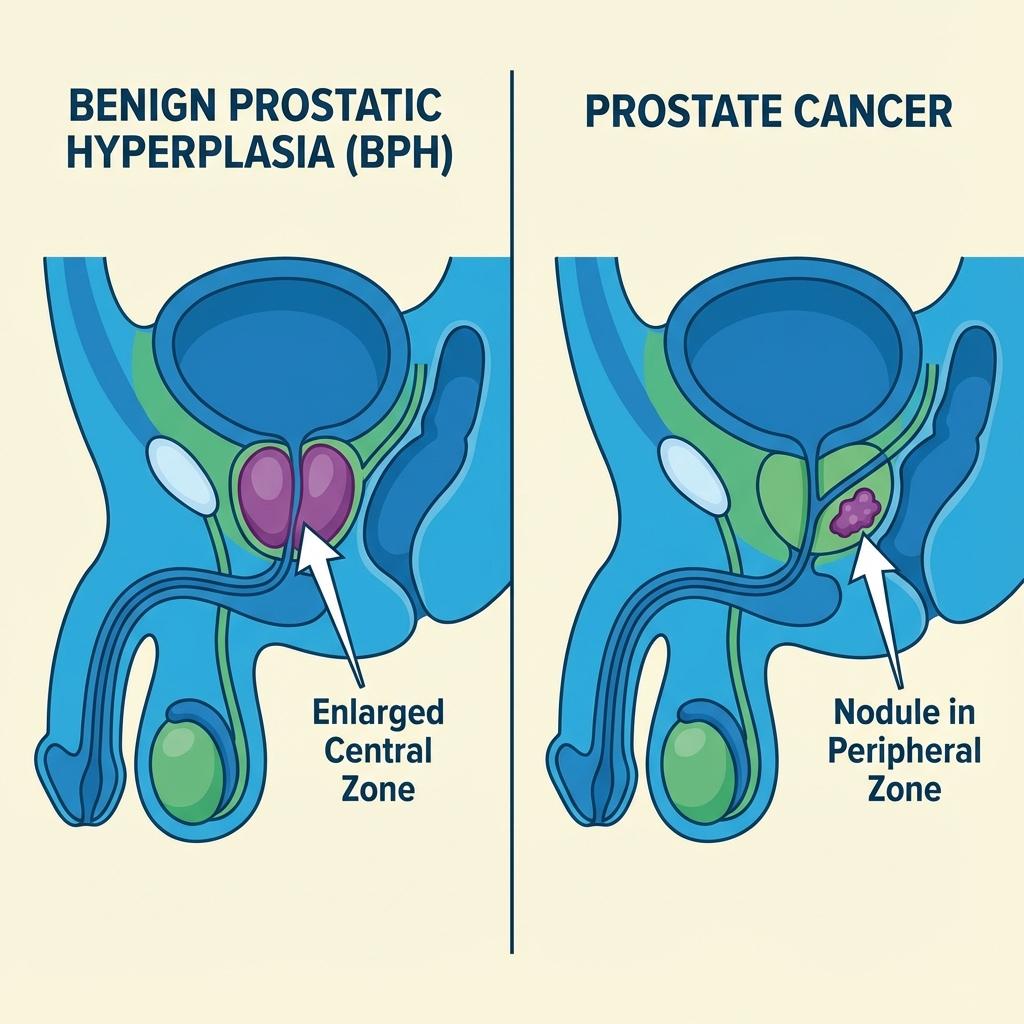
1. Anatomy: Location, Location, Location
The prostate is not a uniform blob of tissue. It has "zones."
BPH: The Transition Zone
BPH occurs in the Transition Zone, which surrounds the urethra (the tube you pee through).
Think of it like a donut hole getting smaller.
As the tissue grows here, it squeezes the urethra inward. This is why BPH causes urinary symptoms early on.
Cancer: The Peripheral Zone
Prostate cancer typically starts in the Peripheral Zone, the outer shell of the prostate (the part felt during a rectal exam).
Because it is on the outside, away from the urethra, early-stage prostate cancer rarely causes urinary symptoms. It can grow silently for years without affecting your ability to pee.
2. The Symptom Paradox
Crucial Fact: Severity of symptoms does NOT correlate with cancer risk.
A man with a massive benign prostate (BPH) might be miserable—waking up 5 times a night, unable to travel without a bathroom map. But he is not in danger of dying.
A man with early aggressive prostate cancer might feel fantastic, have a strong urine stream, and sleep through the night.
Common BPH Symptoms (LUTS):
- Frequency (peeing often)
- Urgency (gotta go NOW)
- Nocturia (waking up at night)
- Weak stream
- Dribbling
3. The Volume Connection
Does a bigger prostate mean more risk of cancer?
Actually, often the opposite.
Studies have shown a "protective" effect of large prostate volume. Men with larger prostates (>55cc) often have lower rates of high-grade cancer compared to men with small prostates. Why?
- Dilution: In a huge gland, cancer (if present) is statistically harder to hit with a needle.
- Biology: The hormonal environment that drives massive BPH growth might be different from the one that drives aggressive cancer.
This is why PSA Density is so important. A high PSA in a small gland is much scarier than a high PSA in a huge gland.
4. PSA Differences
- BPH: Causes a slow, steady rise in PSA over years. Often leads to high Free PSA (>25%).
- Cancer: Causes a rapid rise (high Velocity). Often leads to low Free PSA (<10%).
Comparison Table
| Feature | BPH (Benign) | Prostate Cancer |
|---|---|---|
| Location | Transition Zone (Center) | Peripheral Zone (Outer) |
| Urinary Symptoms | Common & Early | Rare until late stage |
| PSA Rise | Slow, steady | Rapid, erratic |
| DRE Feel | Smooth, elastic, rubbery | Hard, nodular, rock-like |
Conclusion
If you are having trouble peeing, statistically, it is BPH. It is a quality-of-life issue, not a life-threatening one. However, because cancer is silent, you cannot rely on symptoms to tell you if you are safe. Routine screening (PSA + DRE) is the only way to catch malignancy early.
Need to calculate prostate volume?
Use our free medical-grade calculator to get instant results using the Ellipsoid or Bullet formula.